
Every vendor knows what they are owed before they ask you
An antique mall is a few hundred small businesses sharing a building, a checkout and a set of books. The month-end job is not selling — it is proving to every vendor what they earned, what they owe in rent, and why the two numbers net out the way they do.
A statement, not an argument
Every vendor gets a bank-style ledger: a running balance with every debit and credit itemized — sales, commission, booth rent, recurring fees, adjustments, holdbacks and payouts. They log in and read the same ledger you do.
That single change is what ends the monthly phone calls. The conversation moves from “is this right?” to “how do I sell more?”
Rent and sales are the same ledger
Rent accrues to the vendor’s ledger and settles against their sales, so a vendor who had a good month simply takes home less rent and more cheque, without anyone reconciling two systems.
Charges post on schedule whatever the balance, so nothing quietly goes uncharged — and mid-cycle moves are yours to price, never prorated behind your back.
The floor, as a map
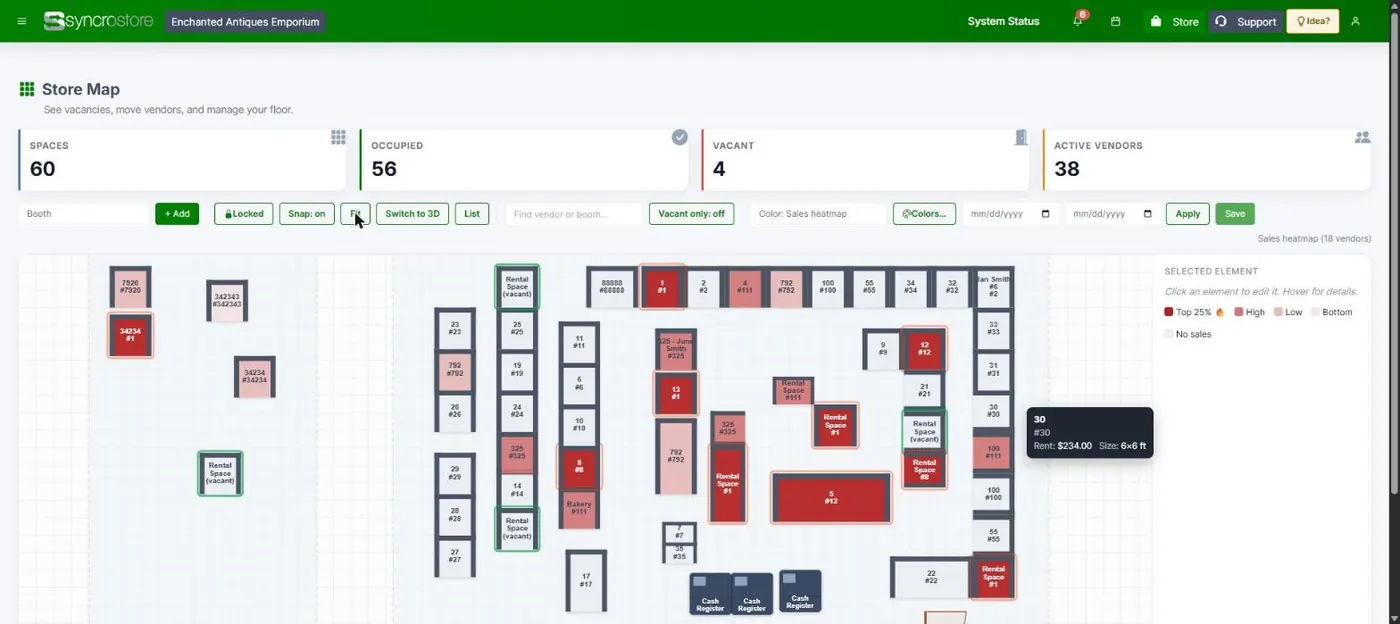
Most malls run their layout on a whiteboard and a memory. Syncrostore draws the building in 2D and 3D, colors it by sales over any date range, and shows which spaces are empty and which are about to be.
Charge what the corner is worth
Once you can see which spaces earn, rent stops being a flat number you inherited. The heat map is the argument for why the aisle-end booth costs more than the one by the stockroom.
See what is coming empty
Open booths, upcoming move-outs and renewal dates sit on the plan rather than in someone’s head, so you are filling a space before it goes quiet instead of after.
Vendors on the plan
Assign a vendor to a booth and track move-ins and move-outs. New staff learn the floor from the map instead of from a fortnight of being told.
At the counter
Ten vendors, one basket
A single transaction can hold goods from ten different vendors. Every line attributes to its owner at the moment of sale — commission, rent offset and tax handled before the receipt prints.
Tags that survive a move
Labels carry vendor, price and a Global ID barcode, so a piece can move to another of your buildings without being retagged.
Dual pricing, built in
Cash and card pricing runs natively at the register with a savings report, and under Vendor Choice Pricing the card fee follows the vendor who opted out rather than the mall.
Questions malls ask us
We have 300 vendors. Is that a problem?
No — that is the case Syncrostore was built for first. Vendors are unlimited on every plan.
Can vendors enter their own items?
Yes. They get a login and add stock themselves, from home if they prefer, and see their sales and balance without asking the office.
Do you handle several buildings?
Enterprise runs multiple locations on one set of books with consolidated reporting and cross-store transfers. Pricing is here.
How do we get our vendor list across?
Import templates for vendors, inventory and open balances are included, and we walk you through the first run on a call rather than handing you a spreadsheet. You are not retyping three hundred vendors.
Bring your worst month-end
Thirty minutes in the live software. Bring the spreadsheet you dread and we will show you what it looks like as a settlement run.