
Multi-vendor POS: one register for a store full of separate businesses.
A multi-vendor POS has one job an ordinary register cannot do: take a basket holding goods from a dozen different owners and get every cent to the right person. Everything else — rent, commission, payouts, reporting — follows from getting that right at the moment of sale.
Figures as of September 2026.
Why an ordinary POS cannot do this
Single-tenant POS software assumes the store owns the stock. Every report, every total and every payout is built on that assumption. Put a hundred independent sellers in one store and the assumption quietly breaks — not with an error message, but with a month of reconciliation.
The basket is the hard part
One customer buys from six vendors in one transaction. If attribution does not happen at the moment of sale, someone rebuilds it later from an export — and that person is you, on the first weekend of every month.
Vendors check your arithmetic
A vendor who cannot see their own numbers has to take yours on faith. That works until it does not, and the disagreement always lands in the same place: your afternoon.
It fails quietly at volume
Screenshotting a report per vendor per month is fine at ten. At eighty it is a part-time job, and at two hundred it stops happening properly at all.
What Syncrostore does instead
Per-line attribution
Unlimited vendors per transaction. Each line knows its owner, and commission, rent offset and tax are settled before the receipt prints — not reconstructed afterwards.
A ledger they can read
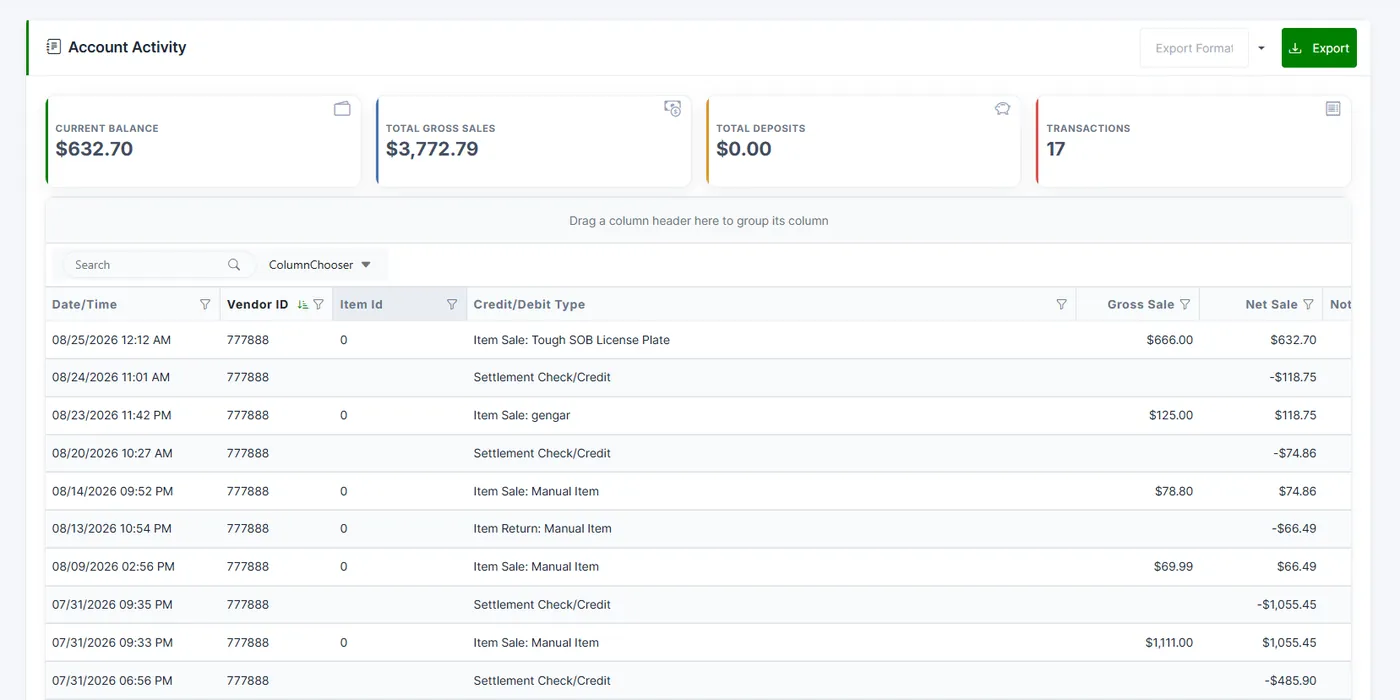
A running balance with every debit and credit itemized, visible to them through their own portal. Both sides read the same number, which is the whole point.
A cycle, not a weekend
Preview a settlement run, adjust line by line if you need to, then pay by ACH through SyncroACH™ or print checks from the same run.
Rules, written once
Rent by the space, a custom commission rate per vendor, and recurring fees that post every cycle. Described once, applied without anyone remembering to.
Not silently absorbed
Card fees are accounted for on the vendor ledger rather than swallowed by the store, and dual pricing is native with a savings report.
Admin, Manager, Cashier, Vendor
Four permission groups and an audit trail on the records that matter, so a vendor sees their business and a cashier sees the register.
Whatever you call your store
Shop-in-shop retail, vendor mall, retail collective, craft mall, antique mall, consignment shop, weekend market — the vocabulary changes and the accounting problem does not. Syncrostore is one system underneath all of them.
Multi-vendor POS questions
What is a multi-vendor POS?
A point-of-sale system built for a store where many independent vendors sell under one roof. It records which vendor owns each item at checkout, keeps a ledger for every vendor, and turns sales, rent, commission and fees into a settlement and a payout.
Can a general retail POS handle multiple vendors?
General retail systems are built around one owner’s inventory, so working out what each vendor is owed usually means exports, spreadsheets or add-on apps. A multi-vendor POS does that attribution at the register, on every line of every sale.
How do vendors get paid?
At the end of each cycle an admin or manager runs the settlement. Sales, rent, commission and fees net out on each vendor’s ledger, then payouts go by ACH through SyncroACH™ or as printed checks from the same run. Managers can run a settlement from their phone.
Is there a per-vendor fee or a vendor limit?
No. There is no per-vendor software fee and no cap on vendors. If you use SyncroACH™ for payouts, it has its own published per-transaction fees.
How much does it cost?
$199.99 a month with SyncroPay™ and Vendor Choice Pricing, or $329.99 a month bringing your own payment processor. Additional registers are $19.99 a month each, with one included. See pricing for everything that is included.
Can it run more than one location?
Yes, on the Enterprise plan: several buildings on one set of books, consolidated reporting, cross-store transfers, and combined settlements, so a vendor in several of your stores gets one deposit or check with anything owed in one store netted against sales in another.
Can vendors bring their existing catalog?
Yes. Syncrostore imports Shopify inventory directly, or takes our spreadsheet template, and variants come across as variants. Vendors can also enter and price their own items remotely if you allow it.
See it ring up a mixed basket
Thirty minutes in the live software. We will build a basket from several vendors and follow the money all the way to the payout.