
Software for stores where the job is volume, not margin
A thrift store turns over more items in a week than most retailers touch in a quarter, at price points where nothing justifies a slow process. The software either keeps up with tagging, pricing and markdown, or it becomes the bottleneck the whole shop works around.
Thrift Pro · $199.99/mo with SyncroPay™ · $329.99/mo software-only · what is in it
Seconds per item, thousands of items
At thrift price points, every extra second in intake is a cost you cannot recover on the sale. So the questions that matter are dull and practical: how fast does an item get tagged, how does markdown happen without touching each piece, and how do you know what is actually moving.
Syncrostore answers those before it answers anything clever.
Markdown without walking the floor
Color, date, category and volume discount rules run at the register rather than on the price tag. A color goes half price on a schedule you set, and no one re-tickets a rail to make it happen.
The cashier does nothing differently. The rule applies when the item scans.
Where thrift gets complicated
Transfers that do not need retagging
Every tag carries a Global ID, so an item moving from one of your stores to another keeps its identity. Enterprise adds cross-store inventory transfers and consolidated reporting across every location.
A ledger for anyone who is owed
Many thrift stores mix owned stock with consigned pieces or rented space. Anyone who is owed money gets a bank-style ledger, a login, and settlements by ACH or printed check — the same machinery whether you have four of them or four hundred.
Fast checkout, correct attribution
A single basket can hold items belonging to several different owners. Each line attributes to its owner at the moment of sale — commission, rent offset and tax handled before the receipt prints.
Dual pricing, natively
Cash and card pricing is built in, with a savings report that shows what you actually offset. On low-margin stock, processing cost is not a rounding error.
Import instead of retype
Shopify inventory imports or our own spreadsheet template. Variants and attributes handle the same piece in different colors, sizes or scents without duplicate records.
Roles for a floor with turnover
Admin, Manager, Cashier and Vendor groups, plus an audit trail on the records that matter including price overrides. Useful when the register is staffed by people who started last week.
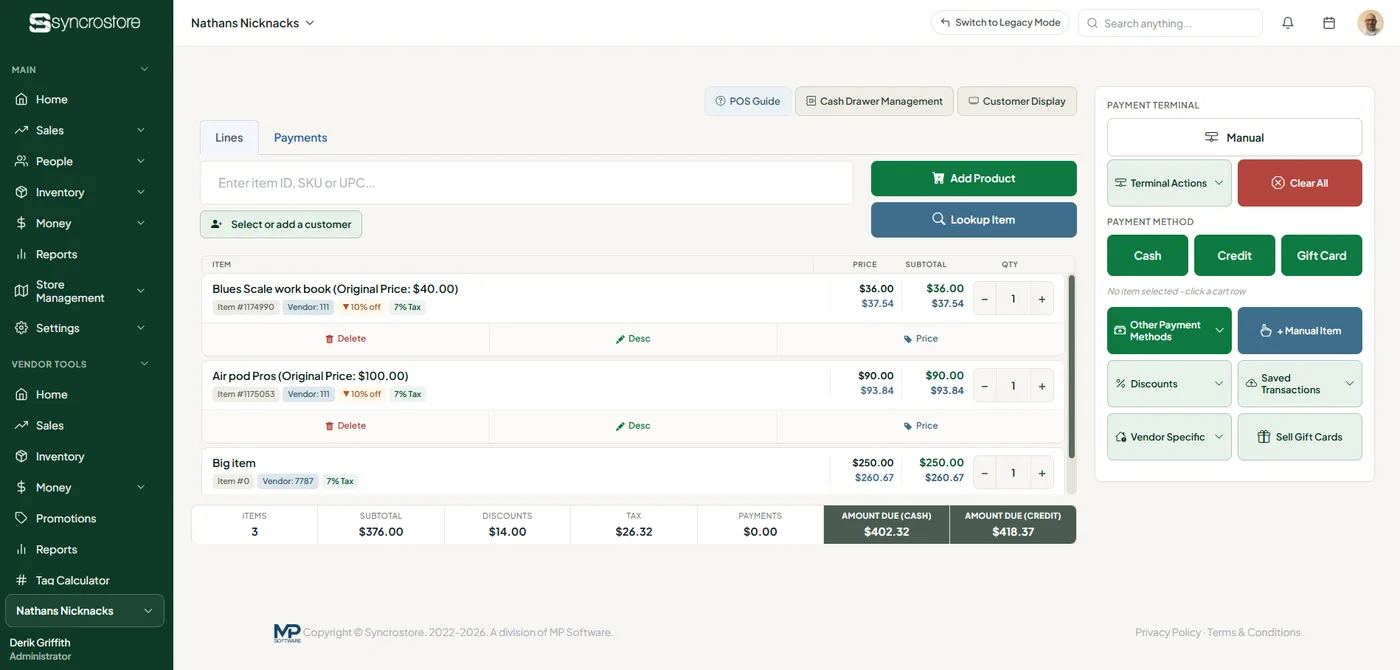
The register, mid-sale
We are a single shop with no consignors. Is this overkill?
No — that is the store Thrift Pro is built for. Everything in your store is yours, so there are no ledgers, commissions or payouts in the plan and you are not paying for them. What you get instead is the intake, tagging, markdown and reporting side, tuned for volume.
What is the difference between Thrift Pro and Consignment Pro?
Whether anyone gets paid out of your sales. Consignment Pro adds vendor and consignor ledgers, automated commissions, booth rent, settlements and payouts. Thrift Pro leaves all of that out. They cost the same — $199.99/mo with SyncroPay™, $329.99/mo software-only — so it is a question of which toolset fits your store, not which you can afford. If you take goods on consignment even occasionally, take Consignment Pro.
Can it handle several locations?
Yes. Enterprise runs multiple buildings on one set of books with consolidated reporting and cross-store transfers. Pricing is here.
Bring a normal Saturday
Thirty minutes in the live software. Tell us your item volume and how your color-tag rotation works, and we will show you what the week looks like.